
Institut de systématique, évolution, biodiversité | ISYEB
ISYEB
-
Unité mixte de recherche
L'ISYEB a pour objectif d'étudier l'origine de la biodiversité, la diversification des espèces et l'établissement de communautés en relation avec l'évolution des taxons dans le temps et dans l'espace. L’unité est l'un des pôles européens de la systématique et contribue de manière significative aux domaines de la taxonomie et de la biologie de l'évolution. Nous effectuons des approches intégratives en systématique phylogénétique qui ont permis de développer des outils taxonomiques, moléculaires, génétiques, acoustiques, cytogénétiques, morphologiques et morphométriques.
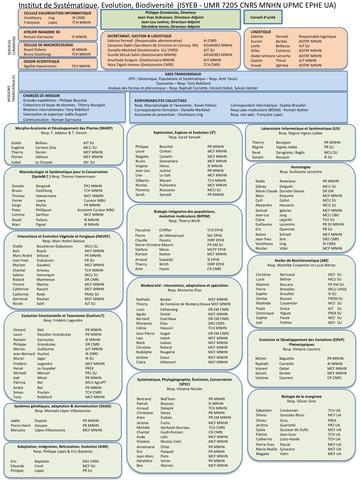
Équipes
- Adaptation, intégration, réticulation, évolution (AIRE)
- Atelier de bio-informatique (ABI)
- Biodiversité: interactions, adaptations, spéciation
- Biologie de la mangrove
- Biologie intégrative des populations, évolution moléculaire
- Évolution et développement des variations phénotypiques
- Évolution fonctionnelle et Taxonomie
- Exploration, espèces et évolution (3E)
- Homologies
- Interactions et évolution végétale et fongique
- Laboratoire informatique et systématique
- Macroécologie et systématique pour la conservation
- Morpho-anatomie et développement des plantes
- Systèmes génétiques, adaptation & domestication
- Systématique, phylogéographie, évolution, conservation (SPEC)
Direction
-
Philippe Grandcolas
Direction adjointe
-
Jean-Yves Dubuisson
-
Jean-Lou Justine
-
Géraldine Veron
Administration
-
Sabrina Permall
-
+ 33 1 40 79 38 10
Communication
-
Romain Garrouste
-
+33 1 40 79 38 72
-
Françoise Lopez
-
+33 1 40 79 32 10
Autres tutelles
- Centre National de la Recherche Scientifique | CNRS
- École Pratique des Hautes Études | EPHE - PSL
-
Enseignants-chercheurs : 109
-
Chercheurs : 8
-
Personnels d'appui à la recherche : 48
-
Doctorants : 43
-
Post-doctorants : 8
- Atelier 3D
- Plateformes d’analyse ADN/ARN
Publications
Publications sur HAL - Archive ouverte
Toutes les publications sur HALAn Xper3 reference guide for taxonomists: a collaborative system for identification keys and descriptive data
Adeline Kerner, Elie Mario Saliba, Régine Vignes-Lebbe, Rémy Portier, Régine Vignes-Lebbe
European Journal of Taxonomy, 2025, 987, pp.281-302. ⟨10.5852/ejt.2025.987.2875⟩. ⟨hal-05039745⟩
Purine Chemistry in the Early RNA World at the Origins of Life: From RNA and Nucleobases Lesions to Current Key Metabolic Routes
Jean‐luc Décout, Marie‐christine Maurel
ChemBioChem, 2025, pp.2500035. ⟨10.1002/cbic.202500035⟩. ⟨hal-05039937⟩
An unusual new species of Burmesescorpiops Lourenço, 2016 from Cretaceous Burmese amber (Scorpiones: Palaeoeuscorpiidae: Archaeoscorpiopinae), Une nouvelle espèce particulière pour le genre Burmesescorpiops Lourenço, 2016 de l’ambre Crétacé du Myanmar (Scorpiones : Palaeoeuscorpiidae : Archaeoscorpiopinae)
Zaw Dan, Ko Zawgyi, Wilson R. Lourenço
Faunitaxys, 2025, 13 (20), pp.1-6. ⟨10.57800/faunitaxys-13(20)⟩. ⟨hal-05035519⟩
Mixotrophy in orchids: facts, questions, and perspectives
Marc‐André Selosse, Pierre‐louis Alaux, Lara Deloche, Etienne Delannoy, Julita Minasiewicz, Spyros Tsiftsis, Tomas Figura, Florent Martos
New Phytologist, 2025, nph.70106. ⟨10.1111/nph.70106⟩. ⟨hal-05037506⟩
Contact details
Adresse physique
75005 Paris
Adresse postale
75241 PARIS CEDEX 05
-
+33 1 71 21 46 60
Muséum National d'Histoire Naturelle
45 rue Buffon
75005 Paris